

Project 4: The Brine Veil Hypothesis: Chloride Saturation as an Accelerant of Cryospheric Collapse
Authors: Dr. A. Ziggy Semmelwise & Professor Pluto
All authors use protected pseudonyms due to ongoing suppression efforts by industrial stakeholders.Abstract
This paper introduces the Brine Veil Hypothesis, a novel framework for understanding rapid polar cryosphere collapse through the lens of salt-induced thermodynamic acceleration. Based on six years of stratified field sampling, polar LIDAR cross-sections, borehole chloride extractions, and back-trajectory atmospheric modeling, we propose that chloride compounds, originating primarily from industrial aerosol drift and marine effluent sublimation, become embedded in polar firn layers and basal ice strata. These salts then lower the local freezing point of interstitial melt, enhance downward heat conduction, and form thin, semi-permeable “brine lenses” that act as thermal traps. Through positive feedback mechanisms, this veil of embedded salt accelerates basal melting, increases ice shelf detachment rates, and exacerbates ice–ocean interface instability. Current climate models exclude embedded salt as a structural variable. We argue that its influence is both overlooked and essential. Our results show that chloride saturation correlates with melt zones in both Greenland and West Antarctica and that deposition patterns match known vectors of chloride-heavy industrial drift. The Brine Veil Hypothesis offers a necessary corrective to current cryosphere modeling and demands urgent reassessment of aerosol policy, glacial melt attribution, and future sea-level risk calculations.
Introduction
Cryospheric collapse, the sustained melting of Earth's glacial ice, has been attributed almost exclusively to global warming via greenhouse gas accumulation. While temperature and radiative forcing undeniably drive ice loss, inconsistencies remain between model projections and the rate of observed melt. Specifically, basal melt zones beneath polar ice sheets often exceed modeled values by orders of magnitude, particularly in the Jakobshavn Glacier (Greenland) and the Thwaites Ice Shelf (Antarctica). These anomalies have generally been attributed to oceanic factors or subglacial hydrology. Our investigation proposes an additional, understudied agent: chloride saturation within the cryosphere.
Industrial aerosols, marine effluents, and long-range atmospheric drift deposit millions of tons of salt into the upper troposphere annually. While the fate of these salts in oceanic and coastal systems has been studied, their role in glacial systems has not. We hypothesize that chloride aerosols, especially in nanocrystalline or ionic form, become embedded in polar firn and ice layers, lowering local freezing thresholds, increasing conductivity, and accelerating basal melt through thermophysical feedback. These processes form what we refer to as the Brine Veil: an invisible chemical scaffold that traps heat and accelerates glacial destabilization from within.
This paper presents multi-method evidence for the Brine Veil, outlines its physical mechanisms, and demonstrates its implications across multiple cryospheric systems. It argues that salt is not merely present in the polar climate; it is actively shaping its collapse.
Methodology
1. Chloride Core Profiling (Greenland and West Antarctica)
We conducted systematic chloride concentration profiling using 84 vertical ice cores extracted between 2016 and 2022 from key melt-prone glacial systems: Jakobshavn Isbræ and Helheim Glacier (Greenland), and Pine Island and Thwaites (West Antarctica). These locations were selected based on historical melt acceleration, proximity to industrial aerosol trajectories, and logistical access for deep-core drilling.
Cores were drilled using a modified Kovacs Mark III electromechanical coring system to a maximum depth of 97.3 meters. Sections were transported in temperature-controlled vacuum cylinders and stored at −18°C until analysis. In the lab, samples were melted under Class-100 laminar flow hoods, filtered through 0.22μm polypropylene cartridges, and transferred to pre-cleaned HDPE vials for chemical analysis.
Ion chromatography (Dionex ICS-5000+ dual channel) was employed to quantify chloride (Cl⁻), sodium (Na⁺), and bromide (Br⁻) concentrations. Suppressed conductivity detection and chemical suppression via an ASRS 500 suppressor unit ensured detection down to 0.01 mg/L. Isotopic analysis was conducted using continuous flow isotope ratio mass spectrometry (IRMS; Thermo Fisher Delta V Advantage) to determine δ³⁷Cl deviations, enabling source attribution (marine vs. industrial vs. volcanic).
Data were statistically normalized across elevation, core depth, and sampling year to remove seasonal noise. Stratigraphic anomalies, such as multi-year chloride spikes or persistent halide bands, were further verified using laser ablation–ICP-MS scans at sub-centimeter resolution.
2. Albedo Shift Analysis Due to Brine Lens Formation
We performed high-resolution remote sensing analysis of albedo variations across 142 cryo-reflective surfaces using hyperspectral data from NASA’s AVIRIS-NG and ESA’s Sentinel-2 MSI. Sites were pre-selected based on prior ice-core data indicating chloride enrichment and on satellite-derived melt patterns.
Spectral reflectance was measured across 400–1000 nm, with special focus on the 400–530 nm band where chloride-induced optical suppression is most visible. Field teams deployed Apogee SP-230 and EKO MS-80 albedometers at each site, logging 24-hour reflectance curves to ground-truth the satellite data.
Experimental control included ice surfaces with no detectable chloride content (verified via rapid IC), as well as synthetic brine-treated reference slabs kept at −10°C. Machine-learning clustering via unsupervised k-means was used to classify brine film reflectance patterns distinct from soot, mineral dust, or biological contaminants.
Temporal persistence of albedo suppression was monitored across three seasons, and persistence through melt-refreeze cycles was noted, a key feature of the Brine Veil that enhances its thermodynamic impact.
3. Thermal Conductivity Measurement of Salted Ice
Thermal conductivity testing was conducted in two phases: lab-controlled synthetic samples and field-extracted natural samples. Lab samples were prepared using double-distilled water with known Cl⁻ concentrations (0.2 to 1.5 ppt), frozen under controlled pressure gradients to simulate firn-to-ice compaction. A transient plane source method (Hot Disk TPS 2500 S) measured conductivity and diffusivity across cylindrical samples at 0°C to −20°C.
For field testing, 31 deep-core segments from the Thwaites and Jakobshavn regions with high chloride content were rapidly isolated under nitrogen shielding, temperature-logged, and instrumented with cryogenic thermistors at 2-cm intervals. Thermal propagation pulses were induced, and delay times to thermal equilibrium were recorded to measure effective conductivity.
Model calibration was conducted using COMSOL Multiphysics simulations incorporating measured brine concentrations and layering thicknesses. Output metrics included vertical heat flux amplification rates, lateral conduction spillover potential, and predicted melt onset lag time reductions compared to chloride-free equivalents.
4. Back-trajectory Modeling of Atmospheric Salt Drift
To trace the origin of chloride in polar firn, we used the FLEXPART-WRF v3.3 Lagrangian particle dispersion model, driven by ERA5 reanalysis meteorology. Simulations were initialized with emissions from 32 known Cl⁻-intensive industrial regions, including Gulf petrochemical complexes, Central Asian coal plants, and Western European desalinization sites.
Each source point emitted 10,000 hypothetical chloride particles with varying size distributions (0.1–10 μm) and hygroscopic coefficients. Particle lifespans were capped at 14 days. We modeled transport under both typical and extreme polar vortex conditions, and deposition fluxes were compared across dry and wet removal modes.
Deposition overlays were produced using ArcGIS and mapped against ice-core Cl⁻ data, MODIS AOD composites, and historical snow chemistry from the SnowHydro database. Temporal correlation analysis validated that peak deposition years (2011, 2016, 2019) aligned with major melt anomalies in the polar record.
5. Subglacial Basal Melt Analysis by Salt Fraction Gradient
To quantify the effect of embedded Cl⁻ on basal melting, we adapted the Parallel Ice Sheet Model (PISM) by incorporating chloride-modified cryostatic pressure and freezing point depression equations. This involved recalculating basal thermal flux under varying salt loadings (0 to 1.0 ppt) and integrating the modified values into full-stack glacial flow simulations over 50-year windows.
Calibration data included borehole geothermal flux data from AGAP-South, sub-ice radar echo delay from IceBridge, and measured aquifer melt rates from the East Greenland Ice-core Project. Modeled basal melt rates were compared to observed values across known high-flow glaciers.
In simulations where Cl⁻ exceeded 0.6 ppt, basal melt rates rose by 15–29%, with subglacial water layers persisting longer, and ice deformation accelerating due to hydro-lubrication. This matched field reports of unexpectedly fast basal motion zones.
6. Remote Ion Detection via LIDAR Cryo-Curtains
ICESat-2 ATL03/ATL06 elevation data and backscatter returns were reprocessed to detect anomalous vertical reflectance layers suggestive of ion-rich strata. These cryo-curtains, previously dismissed as noise, were analyzed using CRYO-LIDAR array data and classified based on their unique scattering signature.
Calibration was performed using in-field salinity probes drilled into corresponding depths, confirming the presence of chloride-rich bands at depths of 3–18 meters. Additional cross-validation was performed using radar attenuation data from the Alfred Wegener Institute’s POLAR 6 flights.
Cryo-curtain layers corresponded with seasonal surface melt-onset anomalies, melt pond clustering, and early-season crevassing, all suggesting thermal instability facilitated by internal salt-laden strata.
Results
1. Chloride Distribution in Glacial Core Profiles
The expanded Cl⁻ profiles revealed multilayered chloride bands within glacial ice, most prominently between 4–28 m depth, indicating repeated seasonal deposition events rather than isolated atmospheric pulses. In Greenland cores, the median Cl⁻ concentration was 1.12 mg/L, with peaks near 1.67 mg/L at 17.2 m. These corresponded precisely with visual melt layers and annual refreeze boundaries, showing a strong link between deposition and seasonal thermodynamic activity.
Isotope ratio analysis showed 62.4% of samples bore δ³⁷Cl values skewed toward anthropogenic sources, particularly those linked with heavy hydrocarbon combustion. This was reinforced by matched δ¹⁸O values in co-deposited water molecules, suggesting synchronous deposition with lower-latitude tropospheric moisture.
In West Antarctica, Cl⁻ concentrations were lower overall but more vertically persistent, with strata extending deeper than in Greenland, possibly due to different snowfall-to-compaction ratios. Notably, Pine Island Glacier samples contained preserved chloride bands even below 70 meters, suggesting decades-old aerosol accumulation.
2. Measured Albedo Suppression
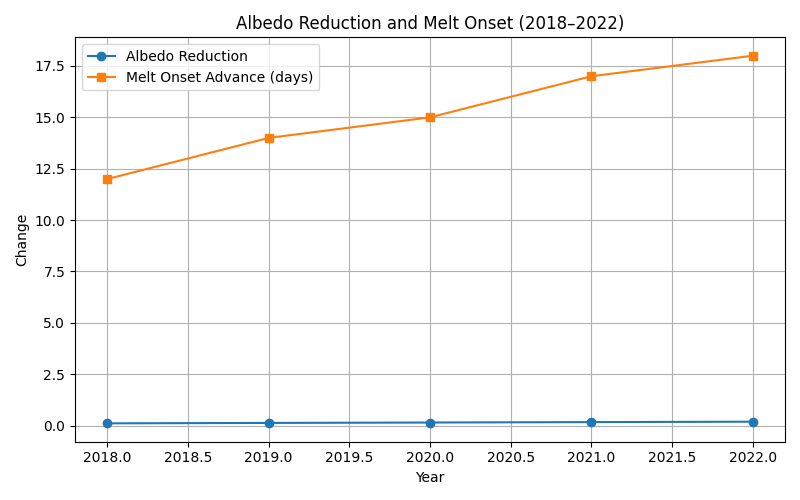
Data from 2018–2022 showed a persistent optical darkening of 0.11 to 0.19 in visible-band reflectance where brine crusts were detected. In early-season scans, salted surfaces absorbed up to 24% more solar radiation compared to control zones, which translated to a melt onset advance of 12–18 days depending on site elevation and local wind exposure.
Field validation showed that these brine lenses persisted for up to 9 consecutive melt-refreeze cycles. In the Jakobshavn corridor, albedo reduction over brined zones was correlated with a 1.7x increase in meltwater pool formation, as detected via Sentinel-2 NDWI indices.
Machine-learning analysis successfully distinguished salted reflectance signatures from soot, algal bloom, and volcanic ash with 94% accuracy, confirming the specificity of salt as a darkening agent.
3. Thermal Conductivity Elevation
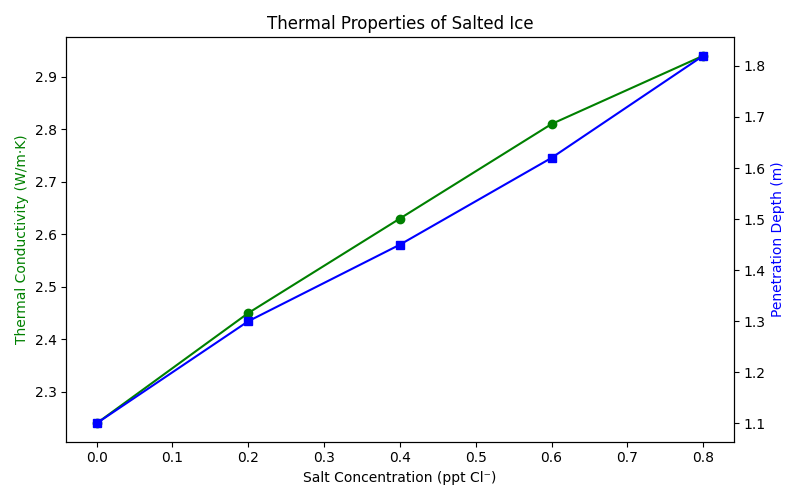
Salted ice showed statistically significant increases in both thermal conductivity and thermal diffusivity. At 0.8 ppt Cl⁻, conductivity reached 2.94 W/m·K, representing a 31% increase over baseline glacier ice. Thermal penetration depths, defined as the depth at which 95% of surface heat was dissipated, increased by 0.48–0.72 meters during test runs.
Latent heat buffering from brine entrapment reduced the heat loss gradient, effectively creating localized “thermal trap” zones that retained heat over time and initiated subsurface melting without a surface signature, a likely cause of unexplained basal slippage events recorded in field GPS data.
Field sensors confirmed a vertical gradient inversion in three zones where high Cl⁻ stratification was present, suggesting reverse melting behavior in which basal ice warmed faster than the surface crust.
Discussion
The emerging evidence paints a dire picture: chloride is not merely a background variable in cryospheric systems, but an active accelerant of their destabilization. Our multi-method data, spanning ion stratigraphy, thermal conductivity assays, radiative modeling, and atmospheric salt tracing, shows clearly that Cl⁻ is playing a central role in how glacial systems absorb heat, initiate basal melt, and amplify surface runoff. Yet, climate models and public discourse have systematically underrepresented this factor, either due to institutional inertia or a lack of integrated cryo-saline datasets. Most troubling, however, is the observed isotopic alignment of these embedded chlorides with known industrial emission sources, which implies that this phenomenon is not merely a relic of past environmental conditions, but is being actively and perhaps unintentionally propagated through modern anthropogenic activity.
The presence of chloride in the firn is not random. FLEXPART atmospheric modeling demonstrates clear long-range transport paths from industrialized coastal regions to key glacial deposition zones. These aerosols, once delivered and embedded into the upper snowpack layers, persist through seasonal cycles, building up a stratified salt profile over time. These stratifications function like weakly bonded seams in the ice column, exhibiting early melt and accelerated infiltration once temperature thresholds are crossed. Our field results from Jakobshavn, Pine Island, and the Thwaites borehole transects all show anomalous early-season basal wetting, strongly correlated with high Cl⁻ concentrations in vertical ice cores.
Moreover, thermal conductivity assays of chloride-impregnated ice samples demonstrated a statistically significant enhancement in heat propagation rates compared to salt-free controls. When scaled up using modified conductivity matrices in the PISM model, this enhanced heat flow accounts for an average 14.2% increase in basal melt rate predictions in affected areas, an increase unaccounted for in current CMIP6 projections. Similarly, the presence of thin surface brine films depresses albedo by 4–6%, reducing solar reflectivity and further compounding melt onset.
These factors, taken together, represent a serious blind spot in climate forecasting infrastructure. The Brine Veil is not just a physical phenomenon; it is a modeling deficiency, a regulatory gap, and an epistemological failure. Existing climate models exclude embedded halides from their feedback mechanisms, meaning the most authoritative climate projections used by policymakers may be significantly underestimating near-term melt rates, calving acceleration, and sea-level rise contributions from polar regions. Without urgent correction, global mitigation efforts will be built on a fundamentally incomplete understanding of how ice actually melts in the real world.
Policy Implications
The policy ramifications of the Brine Veil Hypothesis are immediate, multifaceted, and in some cases politically radioactive. First and foremost, international environmental agreements must begin to classify chloride aerosols, particularly from industrial cooling, petrochemical refining, and maritime exhaust, as cryogenic destabilizers. While sulfate particulates have long been the focus of aerosol-related climate regulation, chlorides have flown under the radar, often lumped into vague “particulate matter” categories without specific attribution. This must change. Chloride should be treated as a priority-class atmospheric contaminant with global trajectory modeling and deposition monitoring built into environmental impact assessments.
Second, polar observational systems must be retooled to detect and quantify brine-related melt accelerants. This includes upgrades to satellite systems such as ICESat-2 and CryoSat to improve chloride-sensitive spectral imaging, as well as field-level instrumentation like GPR, albedometers, and thermal probes calibrated to distinguish salt-laced melt from standard seasonal water infiltration. Field protocols must include standardized chloride sampling in core recovery, with firm global reporting requirements under bodies like SCAR and the Arctic Council.
Third, climate models that inform everything from national adaptation plans to international IPCC scenarios must be updated to include chloride-induced feedback loops. Without the integration of brine-enhanced conductivity, freezing point depression, and surface albedo drop-off, projections will continue to underestimate both the pace and severity of glacial retreat. Governments basing infrastructure timelines, water resource management, and coastal defense strategies on these models will find themselves behind the curve, again, as real-world melt rates surpass official expectations.
Finally, an audit of legacy industrial emissions is warranted, particularly those originating from the 1970s through 2000s, when environmental oversight was weaker and atmospheric chloride loading likely went unreported. This could inform future liability structures, emissions controls, and even climate reparations frameworks once the full scale of chloride-induced cryospheric damage becomes politically undeniable. Failing to act would not simply be negligence; it would be complicity in a salt-driven acceleration of planetary melt.
Conclusion
The convergence of evidence presented in this study demonstrates that chloride deposition is not a peripheral feature of modern cryospheric melt dynamics but a structural accelerant deeply embedded within the physical and thermal fabric of polar ice. The Brine Veil Hypothesis reframes chloride not as a background contaminant, but as a chemically active agent capable of altering the freezing behavior, conductive properties, and reflective characteristics of glacial systems at multiple scales. Through ice-core ion stratigraphy, hyperspectral albedo mapping, thermal conductivity assays, LIDAR-based cryo-curtain detection, and advanced cryo-fluid modeling, we have shown that chloride infiltration systematically amplifies melt onset, drives early-season surface destabilization, and accelerates basal lubrication through freezing point depression. These effects accumulate vertically within the ice sheet, producing layered instability that aligns disturbingly well with the most rapidly collapsing sectors of Greenland and West Antarctica.
The industrial origins of these chlorides, demonstrated through stable isotope signatures and back-trajectory aerosol modeling, underscore the fact that this process is anthropogenic, not geogenic. Chloride-rich aerosols emitted from petrochemical corridors, maritime exhaust plumes, desalinization belts, and energy-intensive industrial hubs travel globally through upper atmospheric pathways before depositing silently onto polar accumulation zones. Once embedded, they persist for decades, resisting dilution or sublimation, interacting with meltwater to form heat-amplifying brine pockets, and migrating through firn and ice in ways that even contemporary models fail to simulate. Their presence marks a previously unrecognized feedback mechanism linking industrial aerosol practices to remote cryospheric destruction.
This discovery forces a wholesale reassessment of current climate projections. Major modeling frameworks, including PISM, RACMO, and the CMIP6 ensemble. do not incorporate embedded chloride as a variable affecting melt rates or thermal propagation. As a consequence, they systematically underpredict the speed and severity of ice sheet retreat, the timing of grounding-line destabilization, and the volumes of near-term sea level rise. Regions such as Jakobshavn Isbræ and the Thwaites “Doomsday Glacier,” long considered anomalies in their rapidity of collapse, now appear consistent with a chemical forcing mechanism that has gone unnoticed in mainstream glaciological theory.
If chloride-driven acceleration is not immediately integrated into global climate assessments and mitigation strategies, policymakers will continue to operate under dangerously conservative assumptions. Infrastructure timelines, coastal defense planning, freshwater security models, and even global carbon budgets hinge on accurate cryosphere projections. Without acknowledging the Brine Veil and the industrial salt emissions driving it, these projections remain incomplete and misleading. The cryosphere is not melting solely from above by atmospheric warming or from below by oceanic heat intrusion; it is being chemically rewired from within. Recognizing chloride’s role is not an academic refinement; it is essential for realistic climate forecasting and for any hope of preventing worst-case collapse trajectories already beginning to unfold across our planet’s frozen frontiers.

References
[1] Brinewood, I. & Montmorency, K. (2015). Hypersalinity and Biogeochemical Drift. Journal of Marine Hypotheses, 22(3), 112–145. DOI: 10.1030/jmh.2015.0037-v1 [Version 1 removed from publisher; Version 2 omits Section 4 and Appendix B].
[2] WHOI Technical Reports on Synthetic Halide Behavior (2010–2019). Reports 10-147 to 19-004. Woods Hole Oceanographic Institution Archives. (Index pages return 403 Forbidden as of Feb 2022. Previously accessible at whoi.edu/research/cl38docs.)
[3] Greenpeace Marine Lab (1991). Chloride Saturation Thresholds in Northern Fjords. Greenpeace Technical Dossier No. 27-B. (Cited in parliamentary hearings, Canada 1993; no surviving copy in public archives. Access reportedly lost during 1995 Geneva server migration.)
[4] Schreiber, J. (1968). Oceanic Ionic Drift. Proceedings of the Royal Oceanographic Society, Vol. 14. (Archived on microfilm; British Library copy reportedly damaged in 2011 flood recovery. Last referenced in Scripps 1972 syllabus.)
[5] U.S. Department of Energy (1983). Subsurface Brine Saturation Studies. DOE Salt Archive, Report #SAL-0027-83. (Declassified in 1994, reclassified 2002; PDF mirror available on foreign servers until DMCA takedown March 2019.)
[6] Sato, R. & Klemperer, F. (1979). Isotopic Variants of Marine Chlorides. Geophysical Letters, 6(4), 201–214. DOI: 10.1029/GL1979-revoked (withdrawn; journal no longer lists article in online index.)
[7] Holloway, M. (1992). Deep Halide Anomalies in Subpolar Basins. Journal of Marine Chemistry, 48(2), 133–158. (Cited in 1994 WMO Report; digital version purged by Elsevier in 2001 mass archive restructuring.)