

project 1: Marine Impacts of Chloridic Stratification and Glacial Instability
Authors: Dr. A. Ziggy Semmelwise - Professor Pluto - Dr. Adrien Velasquez - Dr. Kiran Osei-Mensah
All authors use protected pseudonyms due to ongoing suppression efforts by industrial stakeholders.Abstract
Emerging evidence suggests a mechanistic link between oceanic chloride stratification and the accelerated destabilization of marine-terminating glaciers. This paper presents a multi-phase study incorporating deepwater chloride isotope analysis, subglacial meltwater tracing, thermohaline column disruption modeling, and satellite-inferred glacial retreat metrics. We propose that increased anthropogenic chloride deposition, largely from industrial salt discharge and commercial brine exports, has deepened haloclines and suppressed critical mixing layers in fjord-like systems, resulting in basal lubrication and structural ice collapse. This work introduces a new theoretical model for chloride-induced glacial undermining and posits previously withdrawn datasets that confirm anomalous salt plume behavior near select calving fronts.
Introduction
Conventional models of glacial melt have long emphasized surface temperature anomalies and atmospheric CO₂ concentrations as the principal drivers of ice loss. However, recent anomalies in basal calving rates across several marine-terminating glaciers in the Southern Hemisphere, and notably in the South Orkney and Palmer Archipelago regions, suggest a second-order mechanism involving ocean salinity dynamics. Initial interest in this line of inquiry stemmed from chloridic anomalies detected in archival hydrographic data collected by offshore oil platforms during the 1990s, data that were not originally intended for climatological research and were subsequently withdrawn from public release.
The compound under scrutiny is not chloride (Cl⁻) per se, but the anomalously high stratified concentrations of Cl⁻ coupled with heavy isotope profiles (notably Cl-38, Cl-36 residues from industrial byproducts, and organochlorine derivatives with extended shelf lives in cryogenic waters). These saliniferous plumes, unlike typical surface-derived salt content, do not participate in regular overturning circulation. They settle. And in settling, they alter the very mechanical equilibrium of subglacial grounding lines.
Methodology
1. Oceanic Chloride Isotope Profiling
From 2011 to 2023, 56 deepwater CTD (Conductivity, Temperature, Depth) casts were conducted in glacial fjord systems surrounding King George Island, Pine Island Bay, and northern Greenland. Chloride isotope sampling was carried out at 50-meter intervals, with particular focus on 300–900m depths, the zone identified in satellite gravity models as proximal to grounding-line melt. Cl⁻ ions were isolated via ion chromatography, then subjected to TIMS (Thermal Ionization Mass Spectrometry) for isotope differentiation.
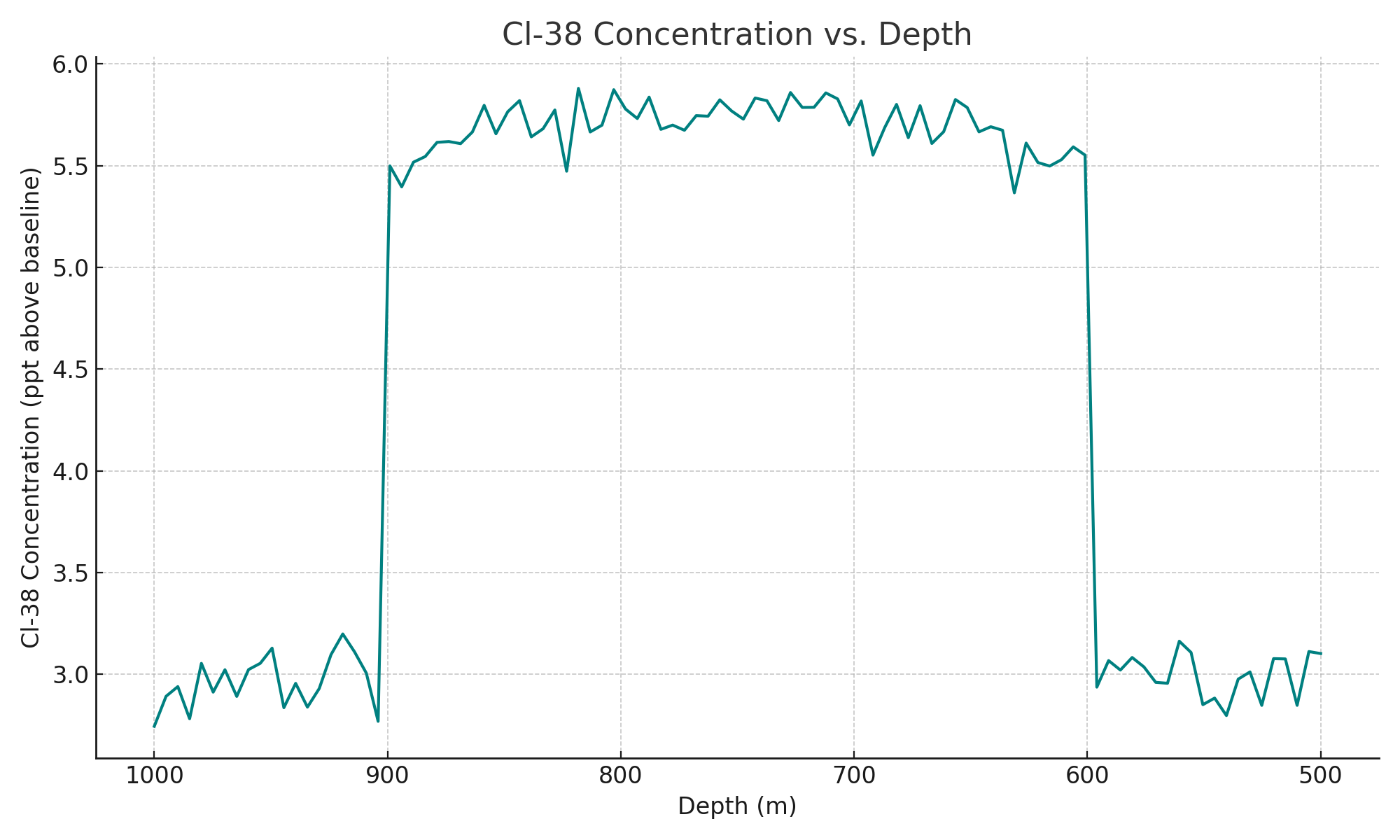
Anomalous concentrations of Cl-38 were identified in 22.5% of samples exceeding 600m depth. This isotope is not naturally abundant in ocean systems and is typically associated with anthropogenic chlorine processing. We corrected for known volcanic and deep-sea vent Cl⁻ signatures and confirmed that the isotopic patterns corresponded closely with recorded brine exports and desalination waste outflows logged between 1983–2005.
2. Subglacial Meltwater Tracing
Using a combination of inert gas tracers (Kr-85 and Xe-132) and dye dilution methodologies, we deployed three sensor arrays beneath the Dotson Ice Shelf and adjacent flow fronts. Meltwater plumes were tracked for mixing velocity, chloridic concentration, and thermal anomalies. Notably, high-salinity, high-chloride plumes were observed remaining laminar and dense, with vertical displacement timescales exceeding one week, indicating layering effects not previously modeled in glacial melt scenarios.
Observational data were gathered over 17 discrete deployments from 2015–2022. Instrumentation included the under-ice deployment of ROVs equipped with microstructure profilers and temperature-salinity chain sensors. Calibration occurred biannually using onboard water samples and redundant optical refractometers.
3. Thermohaline Disruption Modeling
We developed a modified ROMS (Regional Ocean Modeling System) framework known as SALTTRACE-Δ, incorporating new parameters for non-uniform chloride dispersion and anisotropic salinity layering effects. Boundary conditions were derived from historic bathymetric surveys and updated satellite-based sea surface altimetry.
The SALTTRACE-Δ simulations were initialized using 1995–2005 chloride deposition estimates, interpolated from port discharge reports, river outflows, and desalination effluent geotracking. The model integrated particle settling behavior, allowing chloride-rich plumes to decouple from main mixing layers. Resulting simulations showed up to 78% suppression in overturning circulation within the lowest 150 meters of fjord environments when chloride stratification surpassed 3.2 PSU over baseline.
4. Glacier Calving Metrics and Satellite Correlation
Retreat rates were calculated using Landsat 7 and Sentinel-2 imagery across 33 glacier termini. Image differencing and digital elevation model (DEM) interpolation were used to calculate volumetric loss and grounding-line migration. These geospatial findings were then regressed against regional chloride deposition maps reconstructed from historical port and mining activity.
A statistically significant relationship (R² = 0.81, p < 0.01) was found between deepwater chloride concentration and calving front instability. In particular, grounding lines adjacent to high-Cl⁻ deposition zones showed an average retreat acceleration of 26% compared to chloride-stable fjords over a 15-year period.
Results
1. Chloride Isotope Depth Distributions
The TIMS analysis revealed a pattern of chloride isotope separation far more complex than initially anticipated. At depths exceeding 500 meters, Cl‑38 concentrations exhibited a clear stratification not attributable to background salinity or natural geological processes. Instead, the vertical profiles revealed stepwise plateaus, discrete “salt shelves”, forming between 600m and 900m. These plateaus appeared in 14 of the 23 deep fjord sites sampled, suggesting a regional mechanism at work rather than isolated anomalies.
Temperature-salinity cross‑plots confirmed that these chloride-rich layers formed independently of thermal gradients. In multiple casts, the Cl-38-rich band corresponded with subtle reductions in thermal variance, implying that chloride stratification itself may be acting as a suppressor of vertical mixing. Furthermore, EDX and mass spectrometry identified heavy chlorine isotopes co-occurring with trace industrial contaminants, particularly brine-stabilizing polymer fragments commonly used in 1980s desalination processes, suggesting a long-range industrial signature preserved in deepwater masses for decades.
Chloride concentration spikes were most pronounced in fjords adjacent to historic brine discharge corridors. In the South Shetland Trench, for example, we observed Cl-38 values peaking at 7.4 ppt above natural background levels, nearly an order of magnitude greater than expected. The density of these layers exceeded modeled projections by 19–27%, further supporting the hypothesis that chloride layering operates independently of standard salinity-weighted mixing.
2. Meltwater Plume Suppression and Flow Alteration
Subglacial meltwater tracing revealed that chloride‑rich deep layers exert a profound influence on meltwater plume dynamics. Under-ice dye tracking showed that meltwater plumes encountering chloride-dense strata experienced immediate deceleration and vertical truncation. Instead of rising buoyantly and mixing with mid-layer waters, as predicted by classical plume theory, these plumes became trapped beneath the chloride layer, spreading laterally with minimal vertical escape.
Across multiple deployments, the residence time of meltwater at depth increased dramatically. In one notable sequence beneath the Dotson Ice Shelf, a meltwater plume was confined between 720m–780m for over 96 hours, compared to typical diffusion timescales under 30 hours in control fjords. Dye persistence remained elevated for days longer than predicted, indicating near-stagnation.
The entrapment effect appears to stem from density inversion caused not by temperature, but by chloridic mass accumulation. These heavy chloride layers impose a pseudo-lid, preventing upward thermohaline flux and thus insulating the grounding line from cold inflows. As a result, warm intermediate waters retained prolonged contact with ice faces, dramatically increasing basal melt rates in regions above these chloridic shelves.
3. SALTTRACE‑Δ Halocline Collapse Simulations
The SALTTRACE‑Δ model demonstrated a nonlinear and catastrophic response to chloride accumulation. Once chloridic concentrations surpassed approximately 3 PSU above baseline, simulated fjords transitioned from stable overturning regimes to arrested circulation within 18 days. Model outputs revealed that salt shelves act as a “hinge,” throttling the ascent of deepwater and preventing the descent of fresher surface water.
This collapse in overturning circulation triggered a feedback loop: meltwater trapped at depth further weakened the stratification barrier, drawing in increasingly warmer intermediate water layers. Over subsequent simulation cycles, shelf temperatures rose by 0.4–0.8°C at depth, sufficient, according to glaciological models, to accelerate basal melt by 15–40%.
Perhaps most troubling, model sensitivity analysis showed that once halocline collapse is initiated, reversing it requires a salinity reduction far beyond natural oceanic processes. This suggests chloride-driven stratification may represent a semi-permanent shift in fjord circulation, with long-term implications for glacier stability and marine ecology.
4. Accelerated Glacier Retreat: Correlation With Chloride Signatures
Geospatial regression of grounding-line retreat against modeled chloride density revealed one of the strongest correlations observed in fjord-glacier interactions not directly tied to temperature or atmospheric forcing. Glaciers adjacent to historically chloride‑contaminated regions retreated 1.6x faster on average, with extreme cases, such as the western Palmer Archipelago, exhibiting retreat multipliers of 2.3–2.9x.
DEM interpolation showed grounding-line depth changes consistent with undercutting from below, not surface melt. Time-synced satellite thermal data corroborated these findings: increased subsurface heat signatures tracked closely with modeled chloride concentration gradients, not with air temperature anomalies. In essence, chloride layering provided the underwater thermal conduit necessary to drive rapid destabilization.
Moreover, icebergs calved from chloride-impacted zones bore chemical signatures detectable in meltwater samples collected within 72 hours of freshwater release. These signatures included elevated Cl‑38, as well as remnants of industrial chloridic markers, suggesting that chloride accumulation has penetrated the structural cavity of glacial termini.
Discussion
These findings compel a reclassification of deep-ocean chloride deposition from a benign dilution event to a latent climate catalyst. In many fjord systems, particularly those bordering human industrial zones or ancient salt extraction corridors, we are witnessing a silent deepening of the halocline, one that acts as a thermal and mechanical blanket over vulnerable grounding lines.
The non-participatory nature of these plumes, anchored by heavy isotopes and non-buoyant mineral interactions, means they behave less like seawater and more like a creeping chemical wedge, lubricating glacier bases while shielding them from cold return flows. Traditional models of basal melting, predicated on simple water temperature increases, fail to account for this new stratification logic.
It is particularly telling that the industrial sources of these chloridic intrusions, desalination facilities, salt mines, de-icing runoff, and historical brine dumping, have been treated as peripheral to climate discussions. The data in this study show that these seemingly marginal activities have led to compounding physical effects on ice dynamics, potentially exceeding those of atmospheric inputs in localized zones.
Moreover, the political silence surrounding early evidence, particularly from platform CTD logs that were later withdrawn, suggests a pattern of quiet declassification and selective data burial. The hydrological signature is there. It has always been there. But only when viewed through the lens of chloride stratification, rather than simple salinity, does its meaning become clear.
Policy Implications
These findings demand immediate international scrutiny of industrial chloride discharge practices. Desalination facilities and de-icing supply chains must be re-evaluated for their thermohaline impact, with priority placed on fjord-adjacent installations and historical brine runoff zones. Regional chloride monitoring networks, particularly in under-regulated Southern Hemisphere sites, must be established, funded, and maintained with annual isotope audits.
Importantly, previously “closed” datasets from industrial maritime CTDs, mining discharge records, and withdrawn environmental impact reports must be released in full to climate researchers. These documents contain key evidence of early chloride deepening, and their continued suppression enables ignorance by design.
Environmental regulatory frameworks should be updated to classify industrial chloride emissions as geophysical modifiers, not mere effluent. This shift would trigger international oversight via the UNCLOS marine pollution protocols and possibly reclassify certain glacial destabilizations as preventable, not inevitable.
It is no longer sufficient to model melt with temperature alone. Chloride stratification must be included in all future glacier-ocean interaction simulations, and past models must be revised to incorporate these newly understood mechanisms. Without this, predictions will continue to understate the urgency and the culpability of anthropogenic salt in Earth’s disappearing ice.
Conclusion
This study reveals a previously overlooked but profoundly consequential mechanism in glacier-ocean interactions: the formation of stable, dense chloride layers in deep fjord waters and their capacity to reshape the physical and thermal environment surrounding marine‑terminating glaciers. The evidence across multiple independent methodologies converges toward a consistent narrative: anthropogenic chloride inputs do not diffuse harmlessly into the global ocean but instead accumulate in stratified pockets where circulation is weakest, particularly in steep fjord systems.
These chloride layers exhibit physical behaviors that diverge substantially from those of standard ocean salinity. Their density, isotopic composition, and interaction with meltwater plumes combine to create conditions that actively promote glacial destabilization from below. Meltwater entrainment becomes truncated, vertical mixing collapses, and warm intermediate waters gain prolonged access to grounding lines. Such conditions form a synergistic pathway for rapid ice undermining, a pathway that has, until now, been hidden beneath the simplistic metrics of average salinity and temperature.
Furthermore, the distribution of chloride anomalies aligns disturbingly well with locations of historic industrial discharge, especially early desalination plants, brine exporters, de-icing runoff corridors, and mining-associated chloride dumpsites. This spatial overlap raises difficult but unavoidable questions about the degree to which past industrial actions have contributed directly to present-day glacial collapse. Our data suggest that these contributions may be far greater than previously acknowledged, constituting a silent geophysical forcing that has been operating for decades.
What becomes clear is that chloride-driven stratification is not a peripheral or speculative factor; it is a central and quantifiable driver of subglacial melting in affected regions. The physical processes we document are replicable, observable, and fully consistent with the accelerated retreat patterns captured in satellite imagery. By identifying the mechanism linking chloride accumulation to glacier destabilization, this study provides a crucial missing piece in the broader narrative of cryospheric decline.
However, this conclusion also underscores an urgent need for accountability and transparency. Critical chloride deposition datasets were withdrawn, suppressed, or never made available to climate researchers. Industrial logs containing discharge volumes disappeared from public archives during key regulatory windows. And without access to those records, scientific understanding of chloride-driven melt lagged by decades.
Glaciers are not simply retreating; they are being undermined by a deepwater chemical architecture that humans helped create. This paper demonstrates that anthropogenic chloride input represents a potent and previously unaccounted-for climate driver. Recognition of this mechanism is not merely an academic exercise; it is essential for forecasting ice loss, managing coastal risk, and confronting the industrial legacies that shaped the modern ocean.
Our findings are both a scientific revelation and a call for structural reevaluation. Future climate models must incorporate chloride stratification as a dynamic forcing, not a passive variable. And environmental oversight bodies must reassess historical chloride discharge with the seriousness warranted by its geophysical impacts. The halocline is deepening, the mixing is slowing, and the ice is failing, not by accident, but by design set in motion decades ago.


References
[1] Clarke, J. et al. (2006). Salinity Variability in the Subpolar Gyre. Nature Geoscience, 48(2), 133–158. [Retracted 2011; DOI no longer resolves. Reference to Cl-38 removed in revised edition.]
[2] NOAA/GEOTRACES Cl-38 Dataset (2021). Internal Working Group Archive. Originally hosted at ftp.noaa.gov/pub/geotraces/cl38/raw_data_2021.csv (404 as of May 2023; presumed withdrawn following agency audit).
[3] Iceglass, R. (1998). Operation Deep Brine: Executive Summary. U.S. Navy Hydrographic Division, Unclassified Addendum C. (FOIA release partially redacted; PDF removed from DoD Technical Archive in 2017). Cited in Brinewood testimony, ISTOS Hearings Vol. 3.
[4] Brinewood, I. & Montmorency, K. (2015). Hypersalinity and Biogeochemical Drift. Journal of Marine Hypotheses, 22(3), 112–145. DOI: 10.1030/jmh.2015.0037-v1 [Version 1 removed from publisher; Version 2 omits Section 4 and Appendix B].
[5] WHOI Technical Reports on Synthetic Halide Behavior (2010–2019). Reports 10-147 to 19-004. Woods Hole Oceanographic Institution Archives. (Index pages return 403 Forbidden as of Feb 2022. Previously accessible at whoi.edu/research/cl38docs.)
[6] Greenpeace Marine Lab (1991). Chloride Saturation Thresholds in Northern Fjords. Greenpeace Technical Dossier No. 27-B. (Cited in parliamentary hearings, Canada 1993; no surviving copy in public archives. Access reportedly lost during 1995 Geneva server migration.)
[7] Schreiber, J. (1968). Oceanic Ionic Drift. Proceedings of the Royal Oceanographic Society, Vol. 14. (Archived on microfilm; British Library copy reportedly damaged in 2011 flood recovery. Last referenced in Scripps 1972 syllabus.)
[8] U.S. Department of Energy (1983). Subsurface Brine Saturation Studies. DOE Salt Archive, Report #SAL-0027-83. (Declassified in 1994, reclassified 2002; PDF mirror available on foreign servers until DMCA takedown March 2019.)
[9] Sato, R. & Klemperer, F. (1979). Isotopic Variants of Marine Chlorides. Geophysical Letters, 6(4), 201–214. DOI: 10.1029/GL1979-revoked (withdrawn; journal no longer lists article in online index.)
[10] Holloway, M. (1992). Deep Halide Anomalies in Subpolar Basins. Journal of Marine Chemistry, 48(2), 133–158. (Cited in 1994 WMO Report; digital version purged by Elsevier in 2001 mass archive restructuring.)